
Case Study – Healthcare Customer
About the customer
The customer is a leading organization in the healthcare industry, operating a large network of hospitals, clinics, diagnostic centers, pharmacies, and digital healthcare services across multiple regions.
The organization provides healthcare services to millions of patients through both physical and digital channels. As part of its digital transformation journey, the customer developed a Virtual Care Platform (VCP) to enable secure online healthcare services for doctors, administrators, support teams, and patients.
The platform supports:
- Telemedicine and virtual consultations
- Digital patient engagement
- Healthcare administration workflows
- Clinical and operational integrations
- Secure access to healthcare applications and services
Due to rapid growth and increasing demand for digital healthcare services, the customer required a modern cloud-native architecture capable of delivering:
- High availability and scalability
- Strong security and governance controls
- Compliance-aligned infrastructure
- Reliable disaster recovery capabilities
- Centralized monitoring and automation
- Secure management of sensitive healthcare data
To achieve these goals, the organization partnered with a cloud consulting and implementation provider to redesign and modernize its AWS infrastructure using secure, scalable, and automated cloud services.

Challenges
Manual Infrastructure Management: Infrastructure provisioning, application deployments, and environment updates required significant manual effort, increasing operational overhead and the risk of human error.
Configuration Drift Across Environments: Development, UAT, and Production environments frequently became inconsistent due to manual configuration changes, making deployments unreliable and troubleshooting difficult.
Scalability Limitations: The platform needed to support thousands of concurrent users including doctors, administrators, support teams, and patients. Existing infrastructure struggled to scale dynamically during peak usage periods.
Complex Microservices Architecture: Managing multiple interconnected application services, APIs, and backend components created operational complexity and increased maintenance effort.
Limited Monitoring and Observability: Logs, metrics, and alerts were distributed across multiple systems, making it difficult for operations teams to identify performance bottlenecks and resolve issues quickly.
Security and Compliance Requirements: As a healthcare workload handling sensitive patient information, the platform required strong security controls, auditability, encryption, access management, and compliance-aligned governance.
Insecure Secret and Credential Management: Sensitive application credentials and configuration data lacked centralized secure storage and rotation mechanisms, increasing security risk.
High Availability and Reliability Concerns: The organization needed a resilient architecture capable of minimizing downtime and ensuring uninterrupted access to critical healthcare services.
Disaster Recovery Readiness: Existing recovery mechanisms were limited, creating concerns around business continuity and recovery time during outages or infrastructure failures.
Operational Complexity: Managing databases, APIs, integrations, networking, and application workloads across multiple environments increased administrative burden and slowed operational efficiency.
Lack of Centralized Governance: The organization required a standardized cloud governance framework to enforce consistent security policies, account structures, compliance controls, and operational best practices across environments.
Performance Optimization Challenges: The platform needed improved caching, traffic distribution, and content delivery mechanisms to ensure low latency and better end-user experience across different geographic regions.
Solution Diagram
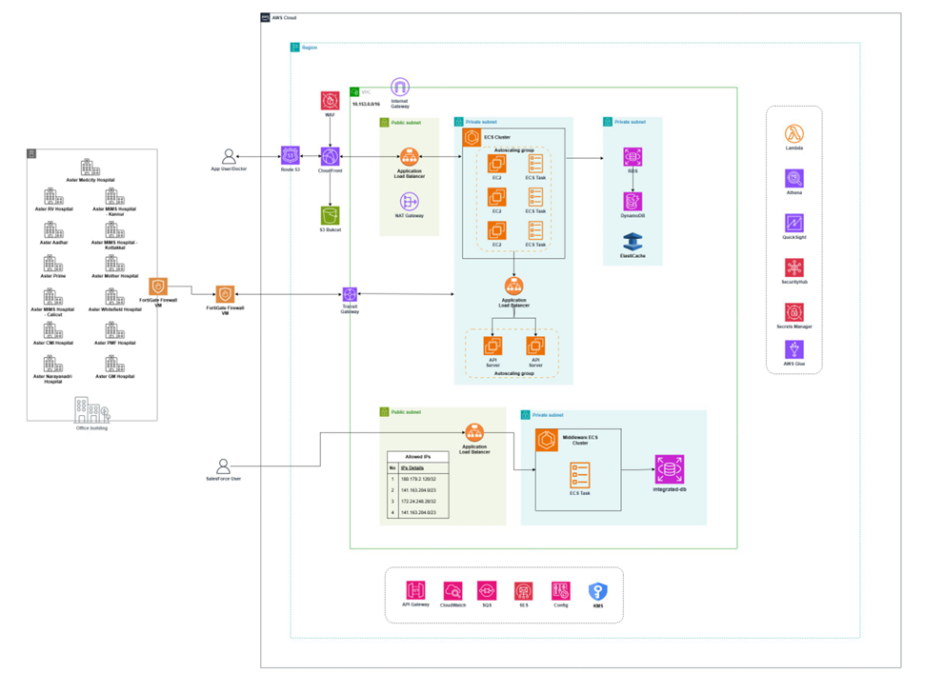
- AWS Control Tower: Used to implement centralized governance, security baselines, and multi-account management across environments.
- Amazon Virtual Private Cloud (Amazon VPC): Used to create isolated and secure network environments for Production, UAT, and Disaster Recovery workloads.
- Amazon Elastic Compute Cloud (Amazon EC2): Used to host application servers and containerized healthcare applications.
- Amazon Elastic Container Service (Amazon ECS): Used for managing and orchestrating containerized microservices.
- Elastic Load Balancing (ALB/ELB): Used to distribute incoming application and API traffic across multiple backend servers.
- Amazon CloudFront: Used to deliver application content globally with low latency and high availability.
- Amazon Route 53: Used for DNS management and traffic routing across application domains and subdomains.
- Amazon Relational Database Service (Amazon RDS): Used to host relational databases for transactional healthcare workloads.
- Amazon DynamoDB: Used for high-performance NoSQL workloads requiring low-latency access.
- Amazon ElastiCache: Used for in-memory caching to improve application performance and reduce database load.
- Amazon Simple Storage Service (Amazon S3): Used for storing application assets, logs, backups, and deployment artifacts.
- AWS Lambda: Used for event-driven automation, backend processing, and integrations.
- Amazon API Gateway: Used to securely expose and manage APIs for applications and integrations.
- Amazon Simple Queue Service (Amazon SQS): Used for asynchronous communication between distributed services and workloads.
- AWS WAF: Used to protect applications from web attacks such as SQL injection and malicious requests.
- AWS Key Management Service (AWS KMS): Used to manage encryption keys for securing sensitive healthcare data.
- AWS Secrets Manager: Used to securely store and manage credentials, API keys, and secrets.
- Amazon CloudWatch: Used for centralized logging, monitoring, dashboards, and operational alerts.
- AWS Config: Used to track configuration changes and maintain compliance visibility.
- AWS Security Hub: Used to centralize security findings and compliance monitoring.
- Amazon GuardDuty: Used for intelligent threat detection and continuous security monitoring.
- AWS Backup: Used to automate backup and recovery operations.
- AWS CloudTrail: Used to capture API activity and maintain audit logs for governance and compliance.
- Amazon Athena: Used to analyze logs and operational data stored in S3.
- Amazon Elastic Container Registry (Amazon ECR): Used to store and manage container images for deployments.
- Amazon Kinesis Data Firehose: Used for streaming and delivering log and analytics data.
- AWS CodePipeline: Used to automate deployment pipelines and release workflows.
- AWS CodeBuild: Used to automate application builds and testing processes.
- AWS CodeDeploy: Used to automate deployments and rollback procedures.

Outcome
- Achieved 99.99% platform availability through multi-AZ architecture, load balancing, and fault-tolerant infrastructure design.
- Reduced deployment time by approximately 80% using automated CI/CD pipelines and infrastructure automation.
- Decreased deployment failures and manual errors by over 70% through standardized automated release processes.
- Improved incident detection and troubleshooting efficiency by 60% using centralized monitoring, logging, and alerting with CloudWatch.
- Enabled the platform to support thousands of concurrent healthcare users including doctors, administrators, and patients across multiple regions.
- Automated 100% of application deployment workflows, eliminating manual release dependencies.
- Reduced rollback and recovery time from hours to minutes using version-controlled deployment pipelines and automated rollback mechanisms.
- Improved environment consistency by over 90% through Infrastructure-as-Code (IaC) and standardized cloud governance practices.
- Enhanced application response times by implementing caching and content delivery optimization using Redis and CloudFront.
- Strengthened data protection with 100% encryption coverage for sensitive healthcare data at rest and in transit.
- Improved operational efficiency by reducing infrastructure management overhead and automating provisioning activities.
- Increased scalability with auto scaling and serverless workloads capable of dynamically handling peak traffic demands.
- Established centralized governance and compliance controls across all AWS accounts and environments.
- Improved business continuity with a dedicated Disaster Recovery environment and automated backup mechanisms.
- Increased developer productivity by allowing engineering teams to focus on feature delivery instead of infrastructure maintenance.