Skip to content
Operisoft black logo
  • ConsultingExpand
    • DevOps
    • Network Services
    • Security Services
    • Monitoring Services
    • AI and ML Services
  • AWS Cloud ServicesExpand
    • GenerativeAI Services
    • Data and AnalyticsExpand
      • Quicksight
    • Migration and Modernization
    • Storage Services
    • Disaster Recovery Service
  • SolutionsExpand
    • infor
    • Cloudlab
  • IndustriesExpand
    • Manufacturing
    • Financial Services
    • Education
    • Pharma And Healthcare
    • Retail
    • Media And Production
  • ResourcesExpand
    • Blogs
    • EventsExpand
      • VMware 2025
      • Webinar Cloud Labs
  • CompanyExpand
    • About
    • Clients
    • Life @OTPL
    • Case StudiesExpand
      • FinTech – Case Study
      • Media – Case Study
      • GJEPC – Case Study
      • Veeda – Case Study
      • healthcare-data-genai-casestudy
      • edtech-genai-casestudy
      • Katyani Plastic – Case Study
      • Cardinal – Case Study
      • Comnet – Case Study
      • IAR – Case Study
      • Enterprise Manufacturing & Distribution – Case Study
      • Healthcare – Case Study
    • Testimonials
    • Career
  • ContactExpand
    • Sales
    • Support
Get free consultation
Operisoft black logo

Enterprise Manufacturing & Distribution Company – Case Study

About the customer

The customer is a large enterprise operating in the manufacturing, food processing, and supply chain distribution sector across multiple regional markets. The organization manages business-critical applications and digital platforms supporting production operations, inventory management, logistics workflows, and downstream distribution services.


With rapidly growing operational demands and increasing dependency on cloud-native applications, the customer required a scalable, secure, and highly available infrastructure platform capable of supporting modern microservices workloads, continuous deployments, and enterprise-grade governance standards.


The organization’s technology modernization initiative focused on improving platform resilience, reducing operational complexity, strengthening security posture, and enabling faster application delivery through automation and cloud-native architecture on AWS.

Challenges

The customer faced several operational, security, and scalability challenges within their existing Kubernetes and cloud infrastructure environment. The legacy architecture lacked automation, proper network isolation, and standardized deployment practices, resulting in increased operational risk and infrastructure inefficiencies.

1. Publicly Exposed Kubernetes Environment

The existing Amazon EKS platform was deployed entirely within public subnets without adequate network segmentation or private workload isolation.

Impact

  • Increased external attack surface
  • Elevated security and compliance risks
  • Lack of secure administrative access controls
  • Direct internet exposure of critical workloads

2. High Infrastructure Costs

The platform relied on EC2-based Kubernetes worker nodes that were consistently over-provisioned to accommodate workload fluctuations.


Impact

  • Poor resource utilization
  • High monthly infrastructure spending
  • Inefficient scaling behavior
  • Increased operational maintenance overhead

3. Manual Deployment Processes

Application deployments and infrastructure changes were managed manually without a structured CI/CD framework.


Impact

  • Deployment inconsistencies across environments
  • Increased risk of production failures
  • Difficult rollback and recovery processes
  • Slower release cycles and operational delays

4. Lack of Infrastructure Standardization

The environment lacked a consistent Infrastructure-as-Code (IaC) framework for managing networking, IAM policies, security groups, and Kubernetes resources.


Impact

  • Configuration drift across environments
  • Increased probability of misconfigurations
  • Difficult infrastructure governance
  • Operational complexity during scaling and upgrades

5. Ingress & Traffic Management Complexity

Legacy ingress configurations and direct service exposure created routing instability and deployment-related downtime.


Impact

  • Service disruptions during updates
  • Routing inconsistencies
  • Increased operational intervention
  • Downtime risks during migrations and releases

6. Limited Monitoring & Observability

Monitoring, logging, and alerting capabilities were fragmented and lacked centralized visibility across Kubernetes workloads and infrastructure components.


Impact

  • Delayed incident detection
  • Slower root-cause analysis
  • Reduced operational visibility
  • Limited proactive monitoring capabilities

7. Frequent Operational Downtime

Architectural limitations, manual operational dependencies, and scaling inefficiencies contributed to recurring platform instability.


Impact

  • Reduced application availability
  • Lower operational reliability
  • Increased support effort
  • Difficulty scaling business-critical workloads

8. Weak Disaster Recovery & Governance

Backup processes, recovery validation, and governance controls were not fully standardized or automated.


Impact

  • Limited confidence in recovery procedures
  • Increased operational risk
  • Inconsistent governance enforcement
  • Higher business continuity concerns
thin

Solution

To address the customer’s operational, security, and scalability challenges, a modern cloud-native architecture was designed and implemented on AWS. The solution focused on improving infrastructure security, automating deployments, optimizing Kubernetes operations, and enabling scalable application delivery using AWS managed services and container-native best practices.


1. Secure Multi-Tier Cloud Architecture

The infrastructure was redesigned using a secure multi-tier VPC architecture distributed across multiple Availability Zones.


Implemented Improvements

  • Designed isolated public and private subnet architecture
  • Migrated all Kubernetes workloads into private subnets
  • Eliminated direct internet exposure of backend services
  • Segregated frontend and backend traffic layers
  • Integrated managed AWS services within secure private networking


Benefits

  • Improved infrastructure security
  • Reduced attack surface
  • Enhanced workload isolation
  • Improved high availability and fault tolerance


2. Kubernetes Modernization with Amazon EKS on Fargate

The legacy EC2-based Kubernetes worker node model was replaced with Amazon EKS running on AWS Fargate.


Implemented Improvements

  • Deployed private Amazon EKS cluster architecture
  • Migrated workloads to Fargate-based execution
  • Enabled pod-level isolation and serverless scaling
  • Eliminated manual node provisioning and patch management
  • Implemented Kubernetes Horizontal Pod Autoscaling (HPA)


Benefits

  • Reduced operational overhead
  • Improved scalability and elasticity
  • Better resource utilization
  • Simplified Kubernetes operations


3. Secure Access & Governance Controls

The platform security model was strengthened using controlled administrative access and improved governance practices.


Implemented Improvements

  • Configured secure Client VPN access
  • Restricted cluster access through private endpoints
  • Hardened security groups and routing controls
  • Applied least-privilege IAM policies
  • Improved workload-level access governance


Benefits

  • Strengthened security posture
  • Controlled administrative access
  • Reduced lateral movement risk
  • Improved compliance readiness


4. CI/CD Pipeline Automation

Manual deployment processes were replaced with automated CI/CD workflows integrated with Kubernetes deployment pipelines.


Implemented Improvements

  • Integrated source code repositories with automated pipelines
  • Automated container image build processes
  • Configured image storage using Amazon ECR
  • Automated Kubernetes manifest deployments
  • Standardized deployment workflows across environments


Benefits

  • Faster and more reliable releases
  • Reduced deployment failures
  • Improved rollback capabilities
  • Elimination of manual deployment dependency


5. Advanced Traffic Management & Ingress Architecture

Application ingress and routing were redesigned using AWS-native load balancing capabilities.


Implemented Improvements

  • Implemented Application Load Balancers (ALB)
  • Enabled path-based traffic routing
  • Configured TLS termination using AWS Certificate Manager
  • Integrated AWS Load Balancer Controller with EKS
  • Structured ingress separation for frontend and backend services


Benefits

  • Reduced deployment downtime
  • Improved traffic routing stability
  • Simplified ingress management
  • Enhanced application availability


6. Centralized Monitoring & Observability

A centralized monitoring and observability stack was implemented for infrastructure and Kubernetes workloads.


Implemented Improvements

  • Configured Amazon CloudWatch for infrastructure logs and metrics
  • Deployed Prometheus for Kubernetes metrics collection
  • Implemented Grafana dashboards for real-time visibility
  • Configured proactive alerting and notification workflows


Benefits

  • Improved operational visibility
  • Faster incident detection
  • Reduced troubleshooting time
  • Enhanced platform monitoring and governance


7. Scalable & Resilient Application Deployment Model

Applications were restructured using modern Kubernetes deployment patterns.


Implemented Improvements

  • Environment-based namespace segregation
  • Independent microservice deployments
  • Internal ClusterIP communication architecture
  • Controlled external exposure through ALB ingress resources


Benefits

  • Improved workload isolation
  • Better scalability and maintainability
  • Simplified environment management
  • Enhanced deployment consistency


thin

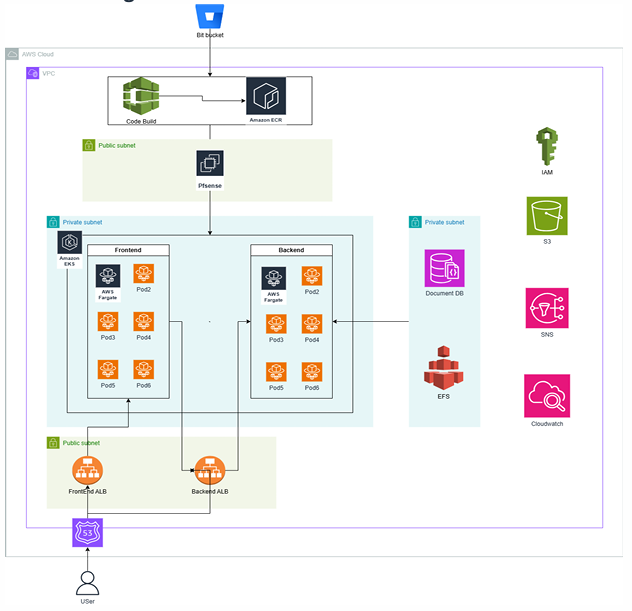
Solution Diagram

  • Amazon EKS: Managed Kubernetes platform used to deploy and orchestrate containerized microservices workloads.
  • Amazon Web Services AWS Fargate: Serverless compute engine used to run Kubernetes pods without managing EC2 worker nodes.
  • Amazon Web Services Amazon VPC: Used to build a secure multi-tier network architecture with isolated public and private subnets.
  • Amazon Web Services Application Load Balancer (ALB): Used for path-based traffic routing, ingress management, and secure application access.
  • Amazon Web Services Amazon ECR: Used to securely store and manage Docker container images for Kubernetes deployments.
  • Amazon S3: Used for object storage, static assets, backups, and application data storage.
  • Amazon EFS: Used to provide shared persistent storage for Kubernetes workloads requiring file system access.
  • Amazon DocumentDB: Used as a managed NoSQL database service for application data storage.
  • Amazon CloudWatch: Used for centralized monitoring, logging, metrics collection, and operational visibility.
  • AWS Route 53: Used for DNS management, domain routing, and high-availability traffic resolution.
  • AWS Certificate Manager (ACM): Used to provision and manage SSL/TLS certificates for secure HTTPS communication.
  • AWS Client VPN: Used to provide secure administrative access to private infrastructure resources.
  • Amazon SNS: Used for alert notifications and proactive operational incident communication.
  • Prometheus: Used for Kubernetes-native metrics collection and workload monitoring.
  • Grafana: Used to create real-time monitoring dashboards and infrastructure visualization.

Outcome

The cloud modernization initiative transformed the customer’s legacy Kubernetes environment into a secure, scalable, and highly automated cloud-native platform on AWS. By redesigning the infrastructure architecture, implementing Kubernetes automation, and adopting serverless container operations, the organization achieved measurable improvements across security, operational efficiency, deployment reliability, and infrastructure cost optimization.

  • Reduced overall Kubernetes infrastructure cost by approximately 35–45% through migration from EC2 worker nodes to AWS Fargate.
  • Improved deployment success rate by over 90% with automated CI/CD pipelines and standardized release workflows.
  • Reduced production deployment downtime by nearly 80% using rolling deployment strategies and structured ingress management.
  • Improved application scalability with automatic pod-level scaling, supporting 2x higher traffic handling capacity during peak workloads.
  • Reduced operational overhead by approximately 60% through elimination of EC2 node management and manual deployment processes.
  • Improved incident detection and response time by over 50% using centralized monitoring, alerting, and observability platforms.
  • Eliminated direct public exposure of critical workloads, significantly strengthening the organization’s security posture and governance readiness.
  • Increased infrastructure availability and platform stability across multi-environment Kubernetes operations.
thin
Operisoft white logo

Quick links ↴

About Us

infor

Industries

Blogs/News

Support Portal

Job Opening

CATEGORIES ↴

Migration and Modernization

Data and Analytics

DevOps

Network Services

Security Services

DR and Business Continuity

Monitoring Services

AI and ML Services

WRITE TO US ↴

info@operisoft.com

support@operisoft.com


Let’s talk ↴

✆ +91 93775 45481 (Sales)

✆ +91 96633 98581 (HR/Career)

✆ +91 79 4105 6868 (Support Desk)

© 2026 Operisoft Technologies Private Limited | All Rights Reserved | Privacy Policy | Terms Of Use | Cookie Policy

Scroll to top
  • Consulting
    • DevOps
    • Network Services
    • Security Services
    • Monitoring Services
    • AI and ML Services
  • AWS Cloud Services
    • GenerativeAI Services
    • Data and Analytics
      • Quicksight
    • Migration and Modernization
    • Storage Services
    • Disaster Recovery Service
  • Solutions
    • infor
    • Cloudlab
  • Industries
    • Manufacturing
    • Financial Services
    • Education
    • Pharma And Healthcare
    • Retail
    • Media And Production
  • Resources
    • Blogs
    • Events
      • VMware 2025
      • Webinar Cloud Labs
  • Company
    • About
    • Clients
    • Life @OTPL
    • Case Studies
      • FinTech – Case Study
      • Media – Case Study
      • GJEPC – Case Study
      • Veeda – Case Study
      • healthcare-data-genai-casestudy
      • edtech-genai-casestudy
      • Katyani Plastic – Case Study
      • Cardinal – Case Study
      • Comnet – Case Study
      • IAR – Case Study
      • Enterprise Manufacturing & Distribution – Case Study
      • Healthcare – Case Study
    • Testimonials
    • Career
  • Contact
    • Sales
    • Support